THE QBRIC PLATFORM
One Platform for Cyber Risk Intelligence and Security Operations.
QBRIC unifies actuarial risk quantification, threat intelligence, vulnerability prioritization, threat hunting, detection engineering, and executive reporting within one coordinated platform.
Seven specialized AI agents operate across six integrated microservices to help organizations move from a published vulnerability to prioritized risk intelligence, validated detection coverage, and audience-specific communication.
PLATFORM AT A GLANCE
A Connected Architecture Built for Risk-Informed Action
6 – Integrated Microservices
7 – Specialized AI Agents
6 – Unified Dashboards
Under 15 Minutes
Published Vulnerability to Validated Detection Coverage
UNIFIED INTELLIGENCE AND COMMAND
Connect Risk, Intelligence, Detection, and Communication
Most organizations rely on multiple tools that each solve one portion of the cybersecurity problem.
A scanner identifies a vulnerability. A threat platform provides intelligence. A SIEM generates alerts. An analyst interprets the findings. A security leader builds a presentation. An executive still has to determine what the risk means to the business.
QBRIC connects those steps through a shared risk intelligence workflow.
✔︎ Vulnerability and exposure data
✔︎ Threat intelligence and MITRE ATT&CK context
✔︎ Actuarial financial analysis
✔︎ Threat-hunting and detection-engineering workflows
✔︎ Operational dashboards
✔︎ Executive and board-ready reporting
The result is a more consistent view of cyber risk across technical and business audiences.
THE QBRIC AUTONOMOUS LOOP
From a Published Vulnerability to Validated Detection Coverage
When a new vulnerability is identified, QBRIC coordinates intelligence, risk analysis, threat hunting, detection engineering, validation, and communication within one connected workflow.
Seven specialized AI agents operate across six integrated microservices, allowing multiple activities to begin in parallel rather than waiting for a manual sequence of analyst tasks.
- Vulnerability identified
- Threat intelligence added
- Financial risk analyzed
- Hunting and detection workflows initiated
- Detection logic developed and validated
- Findings translated for technical and executive audiences
- Human approval applied where required
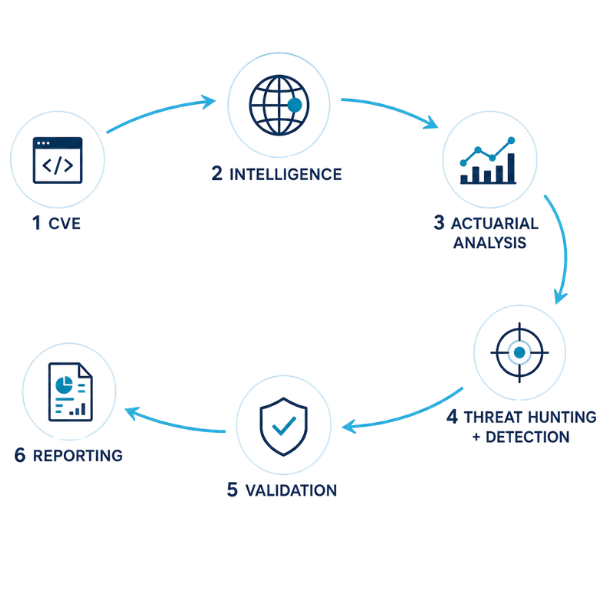
From published vulnerability to validated detection coverage in under 15 minutes, depending on customer configuration and environment.
CORE PLATFORM CAPABILITIES
Six Connected Capabilities –
One Risk Intelligence Workflow
Actuarial Cyber Risk Intelligence
Translate technical exposure into measurable financial context to support prioritization, investment, and executive decision-making.
Threat Intelligence
Correlate vulnerabilities, threat actors, campaigns, indicators, and MITRE ATT&CK techniques with organizational risk priorities.
Vulnerability Prioritization
Evaluate findings using technical severity, active threats, organizational context, and potential financial consequence.
Threat Hunting
Develop risk-aligned hypotheses, generate supported SIEM queries, track hunts, and identify evidence and data gaps.
Detection Engineering
Create, translate, test, and improve detection logic for supported SIEM environments.
Executive Reporting
Translate the same risk information into operational dashboards, executive summaries, and board-ready reporting.
SPECIALIZED AI AGENTS
A Defined Role for Every Agent
QBRIC uses seven specialized AI agents. Each agent has a limited, identifiable responsibility within the larger cyber risk intelligence workflow.
Risk Analyst
Adds actuarial, technical, and threat context to support risk prioritization.
Hypothesis Agent
Maps vulnerabilities and threat information to relevant MITRE ATT&CK techniques.
Intel Agent
Enriches platform activity with vulnerability, actor, campaign, and indicator intelligence.
Sigma Translator
Converts available Sigma logic into supported security-platform queries.
Detection Engineer
Supports the creation, testing, diagnosis, and improvement of detection rules.
Hunt Analyst
Synthesizes threat-hunting evidence, confidence, attack paths, and data gaps.
Communications Agent
Transforms findings into technical, operational, executive, and board-ready communication.
ONE DATA FOUNDATION. MULTIPLE VIEWS.
Give Every Audience the Information It Needs
QBRIC presents the same underlying risk intelligence through six audience-specific dashboard views. Each view emphasizes the information required by that audience without creating separate versions of the truth.
Financial exposure, business impact, risk trends, priorities, and executive-level indicators.
Workflow activity, risk-reduction progress, security priorities, and operational status.
Hypotheses, ATT&CK technique coverage, hunt progress, evidence, findings, and data gaps.
Detection rules, validation status, testing outcomes, supported formats, and coverage gaps.
Threat actors, campaigns, vulnerabilities, indicators, and ATT&CK mappings.
Audience-specific summaries, reports, scheduled briefings, and communication outputs.
ACTUARIAL RISK INTELLIGENCE
Put Financial Context Behind Cybersecurity Decisions
Most security tools describe a vulnerability as critical, high, medium, or low. Those ratings describe technical severity, but they do not explain what the exposure could mean financially or where limited security resources should be directed first.
QBRIC incorporates actuarial cyber risk intelligence to connect technical findings, threat activity, MITRE ATT&CK techniques, and business context with measurable financial exposure.
This gives security leaders a clearer foundation for prioritizing action, evaluating investments, and communicating risk to executives and boards.

Powered by ArxNimbus, the same actuarial engine used to underwrite cyber insurance for 35% of the S&P 500 – with empirical validation of NIST 800-53 controls.

TECHNICAL SCOPE
Built on a Defined and Transparent Capability Set
691
Technique MITRE ATT&CK Reference API
Up to 200
Techniques Covered by Detection Simulation
140
Techniques Currently Supported Within the Threat-Hunting Workflow
316
Rules Available in the Sigma Library
Environment-Specific
Validated Deployment Set
These figures describe different platform functions and should not be interpreted as one shared coverage number. Validated integration and deployment support varies by customer environment.
DEPLOYMENT AND DATA SOVEREIGNTY
Deploy QBRIC Around Your Security Requirements
Cloud
Deploy QBRIC in a cloud environment for centralized management, scalability, and enterprise accessibility.
On-Premises
Operate QBRIC inside the organization’s controlled infrastructure for greater local control over systems and data.
Air-Gapped
Support environments that require localized operation with restricted or no external connectivity.
Hybrid
Separate workloads based on sensitivity, allowing selected capabilities to run in the cloud while protected data and security operations remain locally controlled.
RESPONSIBLE AUTONOMY
AI Accelerates the Work. Human Authority Remains Essential.
QBRIC is designed to support faster cybersecurity operations without removing organizational accountability.
Each organization determines which activities are advisory, which activities may be automated, and which require explicit human approval.
✔ Configurable approval checkpoints
✔ Role-based access
✔ Agent activity logging
✔ Decision rationale and output provenance
✔ Model and prompt tracking
✔ AI Bill of Materials records
✔ Human review of high-impact actions
✔ NIST AI RMF-aligned governance support
Agents advise. Deterministic systems act. Humans gate high-impact decisions.
See How QBRIC Fits Your Environment
A QBRIC demonstration can be tailored around your current security stack, deployment requirements, risk priorities, and executive reporting needs.